Executive function support for adults
Momentum for minds that wander
Diverge surfaces one next action at a time, and is designed to be returned to after you stop. No streaks. No overdue counters. Nothing that piles up while you're away.
01 — Why the last one stopped working
You've done this before. Three to eight apps, probably, plus paper.
The pattern repeats because the tools are built the same way each time — for the enthusiasm of the first week, not the depletion of the sixth.
- 01
Novelty carries adoption
The new tool is interesting, and interest supplies the starting energy.
- 02
Novelty decays
Within weeks it isn't interesting any more. The starting energy goes with it.
- 03
Backlog becomes evidence
Overdue counters and broken streaks turn the tool into a record of what you didn't do.
- 04
You stop, and the stopping counts against you
So the next tool starts from a lower baseline. That's the loop we're built to break.
Other tools are built for the day you install them. Diverge is built for the day you come back.
02 — How it works
One thing at a time, on the day you actually have.
Today's capacity
Everything's available. Small things only. Admin and People are resting.
Next · Admin
Reply to the landlord about the boiler
Survival mode · one small thing
Drink some water
Interface sketch — see v1.3 screens for real product UI
Designed for the day you have, not the day you planned
Two modes: full capacity and survival. When you're depleted, the product adapts instead of asking you to meet it.
Nothing accumulates against you
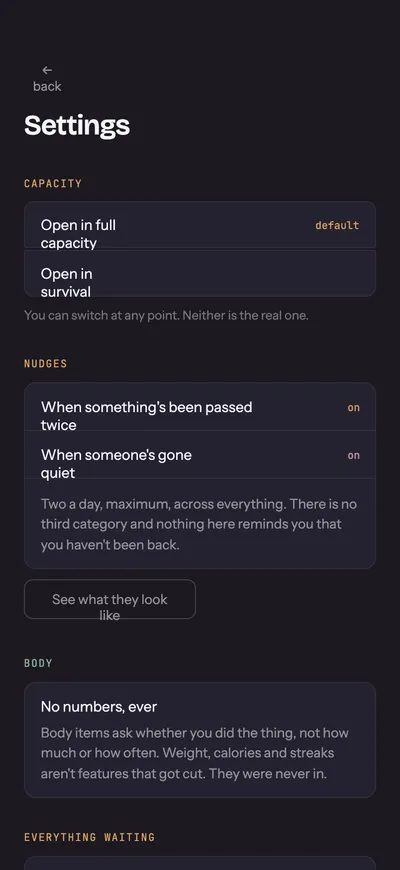
No streaks, no overdue counters, no guilt surfaces. Amnesty clears what's piled up — no review, no justification.
One thing, not a list
A single surfaced next action, and capture in under ten seconds. There is no list view, because the list is the thing that makes you feel bad.
Built to be returned to
Re-entry is a designed flow. Coming back after two weeks away is treated as normal use, because it is.
03 — What it looks like
Four screens, and what each one is refusing to do.
-
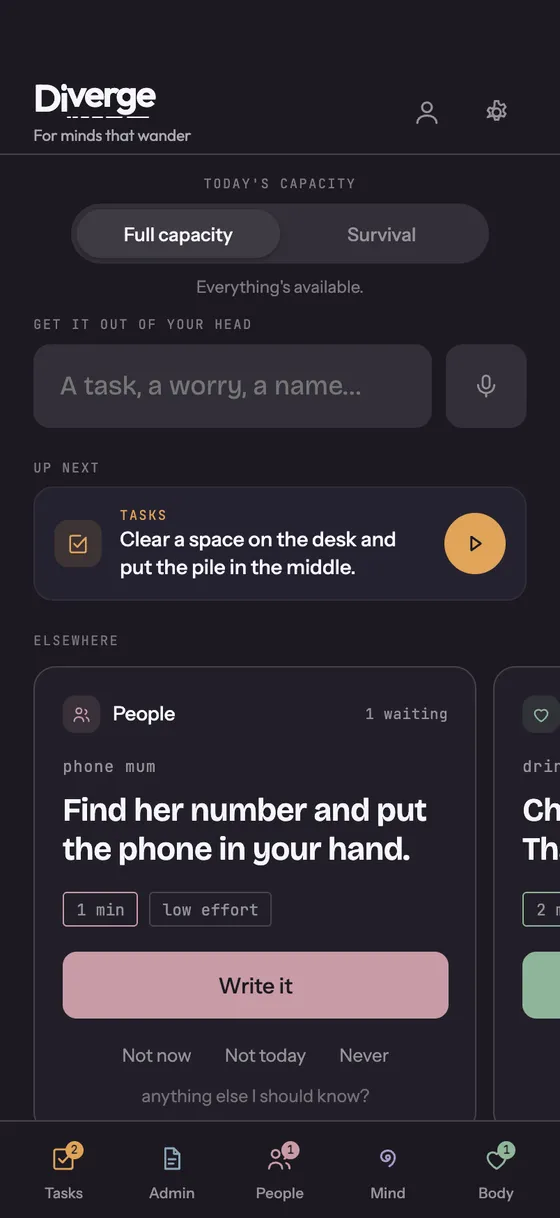
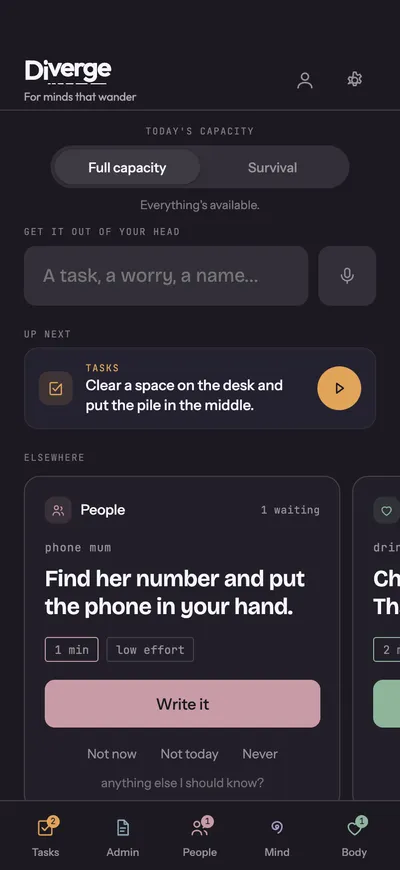
Get it out of your head
One box for a task, a worry or a name. Where it belongs is the product’s problem, not yours — and one thing is surfaced back, sized to the capacity you said you have today.
-
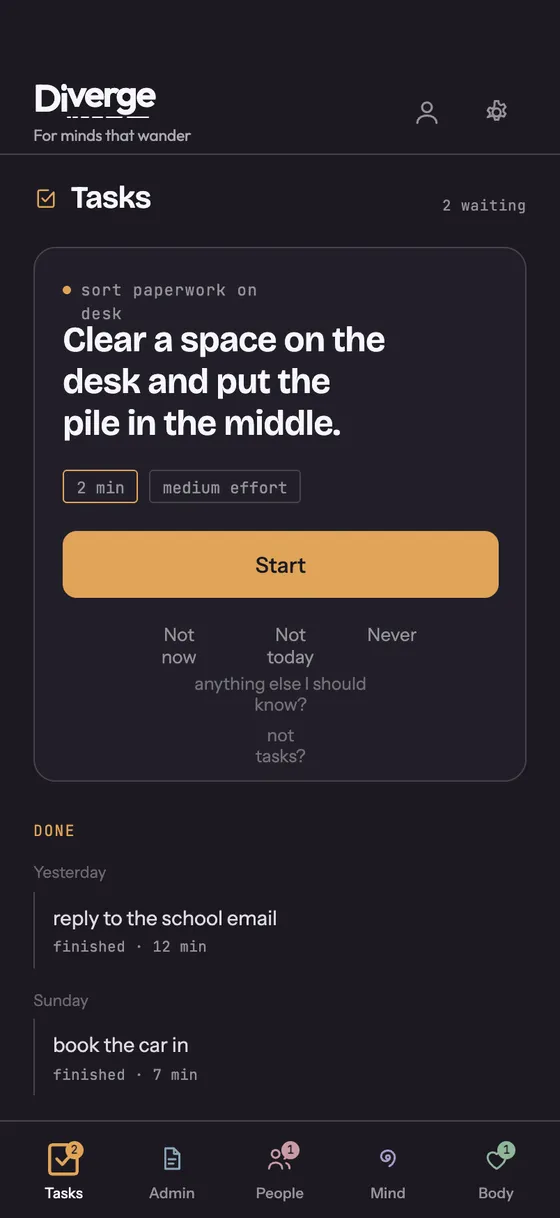
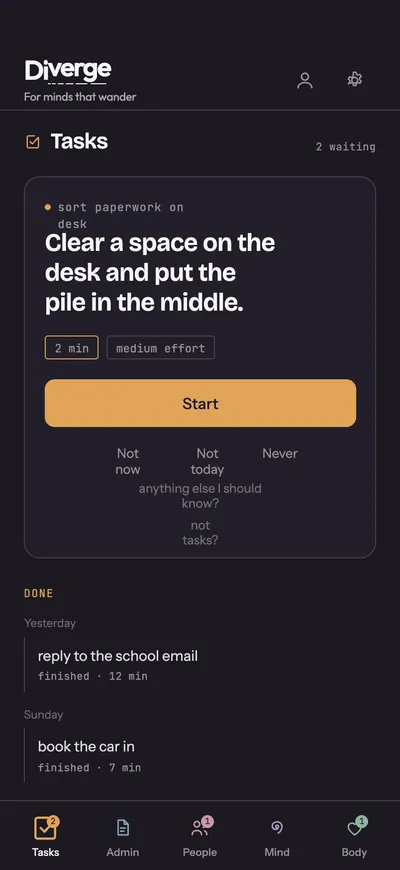
A first step, not a project
The step is physical and small enough to start from a standstill. Not now, not today and never are all one tap, and none of them are held against you.
-
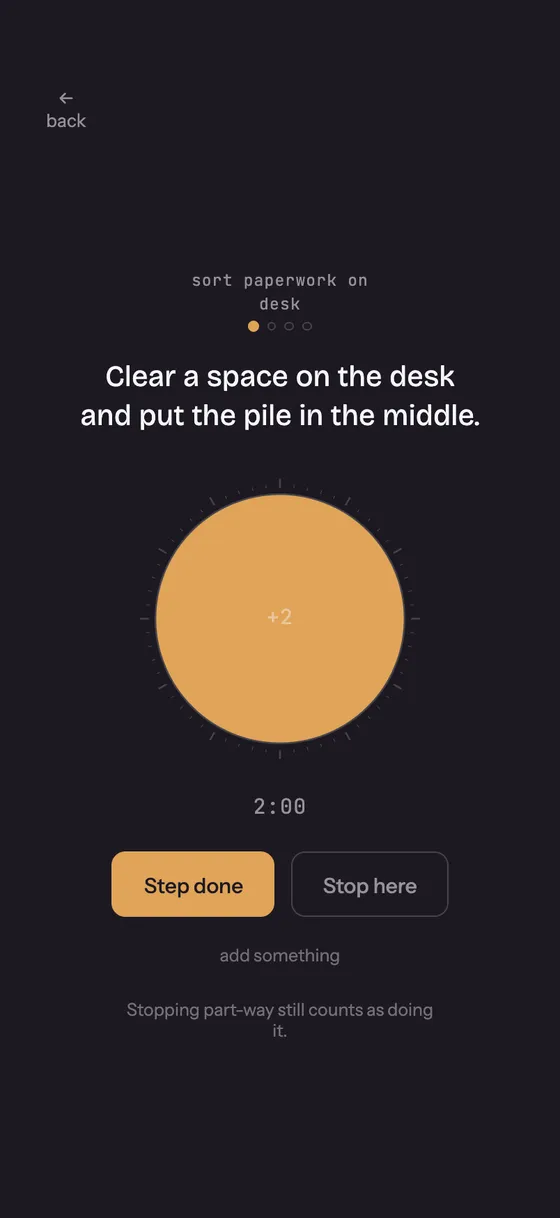
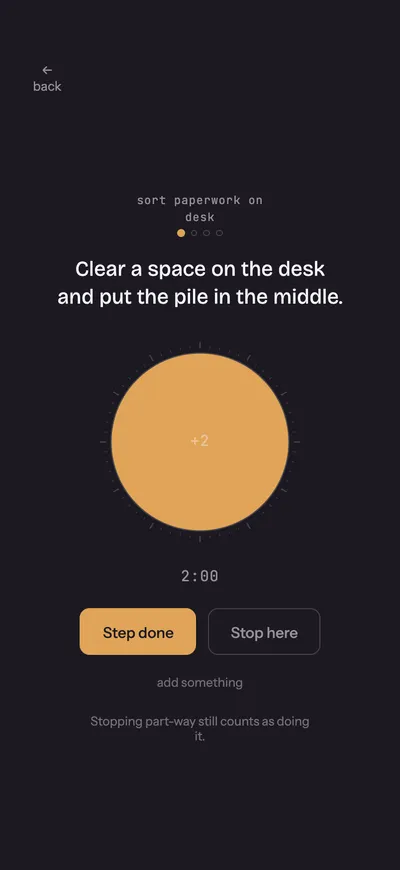
Stopping part-way still counts
A timer you can add two minutes to, and a stop that is a real answer rather than a failure state. What you did before you stopped is what you did.
-
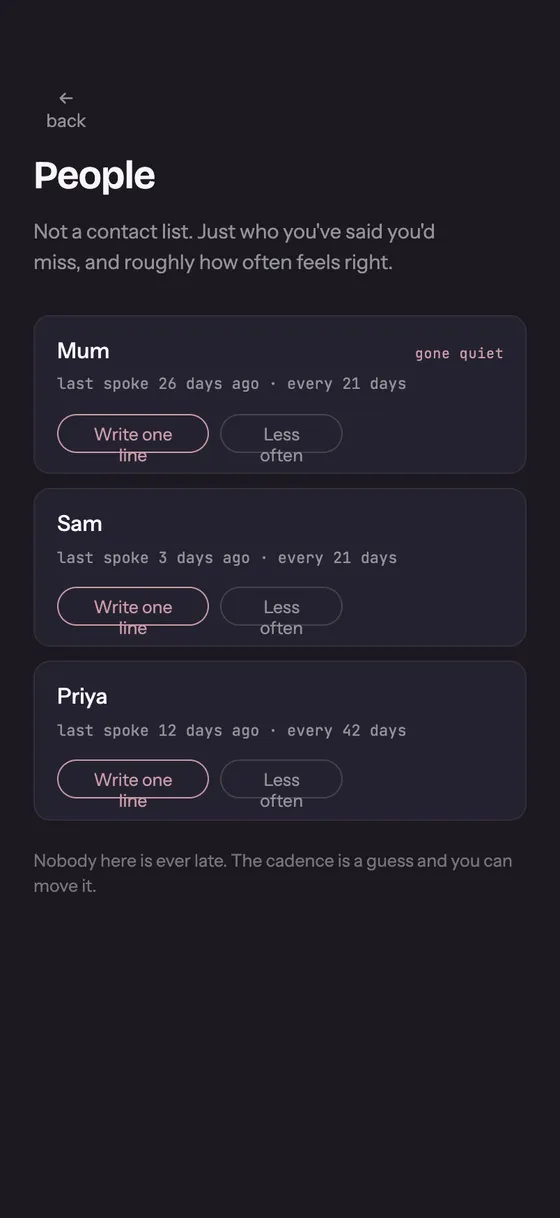
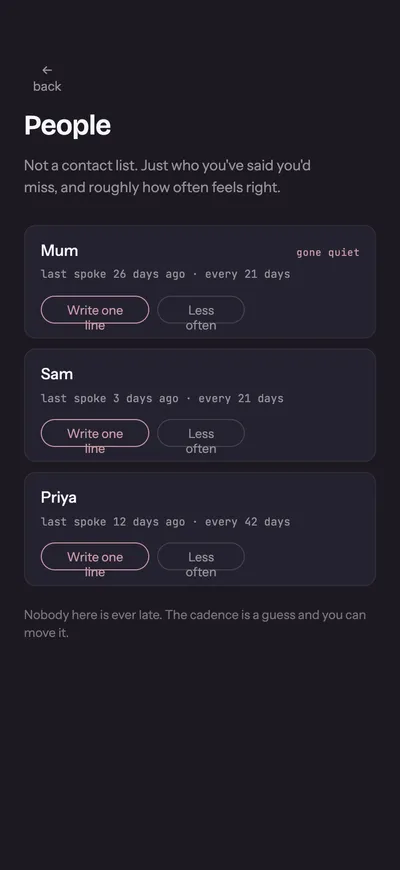
Nobody is ever late
Who you’d miss, and roughly how often feels right. The cadence is a guess and you can move it. Nothing here turns into a number about how good a friend you are.
04 — If you want the mechanism
What's under it, for the sceptical.
You've been promised things before. Here's how the commitments above are actually enforced, so you can judge them.
- Six-primitive engine with domain configuration — Tasks, Admin, People, Mind, Body — so there's depth without setup burden.
- Distress language bypasses all decomposition and routes straight to support resources.
- A global nudge budget, so notifications never become noise you learn to ignore.
- The Body domain restricts numeric tracking by design, rather than leaving it to you to avoid.
- Cadence decay is modelled and handled — the product expects the gap.
05 — Getting started, and stopping
A tool built on coming back can't punish you for leaving.
Free to start, with no card. Pause for as long as you need. Cancelling is a button in settings — not an email you have to write.
- Start without a card
- Always
- Pause your subscription
- Two taps
- Cancel from settings
- Two taps
- Your data leaves with you
- Export anytime
Not ready to start? Get one email when there's something new.
One message when there's something worth trying, and then nothing. It isn't a newsletter, we don't pass it on, and you can ask us to take it off the list at any point.